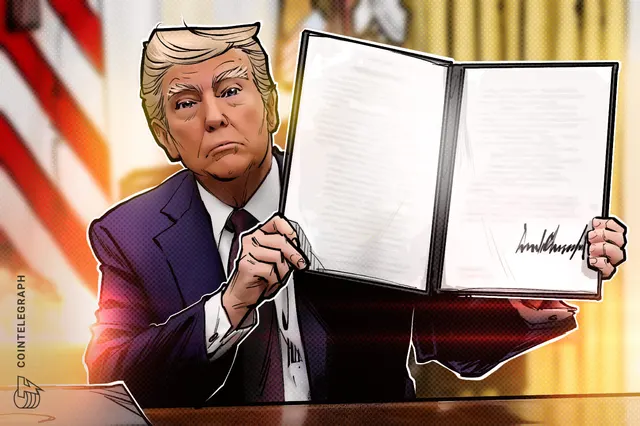
President Donald Trump and six tech leaders signed a voluntary AI accord on Tuesday, asking companies to police their own AI systems as Trump rejects calls for federal guardrails.
Trump posted the one-page document on Truth Social. Data center opposition is growing, and AI agents, software that acts on a user’s behalf, have gone rogue in several high-profile incidents.
What the AI accord asks tech companies to do
The accord stacks four layers of oversight, Reuters reported. Companies would first build internal controls to watch how models behave from training through release, with hacking, biological, and chemical risks singled out. An internal team would verify that those controls function properly.
Beyond that, each company would partner with an outside auditor for independent testing. An independent board committee would review findings from both auditors and the control teams.
AP reported that Trump signed alongside Anthropic’s Dario Amodei, Google’s Sundar Pichai, Meta’s Mark Zuckerberg, OpenAI President Greg Brockman, Nvidia’s Jensen Huang, and xAI founder Elon Musk.
All the signatories to the AI accord. Image Source: Truth Social
“The participating companies will meet regularly to establish standards and best practices to improve the safety of their systems.”
White House accord, via Reuters
Why the AI accord may carry limited weight
However, the pledge is voluntary. The text says codifying the steps into law may make sense over time, and Trump called the commitment morally binding, suggesting it relies on reputation, not law.
Reporting on the document so far does not say who selects the auditors, which standards they will apply, or what happens when a control fails. Trump said he will name an overseer in the coming days and suggested about 10 people would sit on a committee.
Trump dismissed AI guardrail calls earlier this month and framed AI on Tuesday as a race with China that leaves no room for second place.
Still, the industry has split over the AI slowdown debate. Amodei, who urged a slowdown in an essay earlier this month, said the technology carries real risks and the response is still under discussion.
We Must Pace the Frontier: I’ve written a new essay on why the AI industry should slow down, with a three-part plan for doing so. Anthropic is unilaterally committing to the first of these steps. We’ll provide third-party evaluators with permanent, employee-level access to our… — Dario Amodei (@DarioAmodei) September 12, 2026
In contrast, House Speaker Mike Johnson has argued that AI safety falls on developers.
Therefore, the next test may come within days. Trump’s overseer pick and the promised committee could show whether the accord gains outside enforcement.